
KARATE CHAMP – From a Real Arcade Rivalry to BLOODSPORT
Before Bloodsport became one of the defining martial-arts movies of the 1980s, there was another competition taking place — one fought with quarters, two joysticks and a Karate Champ arcade machine.
Future Bloodsport producer Mark DiSalle and Enrico “Rico” Rossi shared a long-standing interest in martial arts, martial-arts films and the culture surrounding them. When Karate Champ: Player Vs Player arrived in the arcades, it quickly became part of their regular routine.
Their Saturdays often included movies in Marina del Rey followed by a stop at Westworld Electronic Amusement Center, where pizza and a $10 roll of quarters turned into roughly twenty head-to-head matches of Karate Champ.
Mark versus Rico. – Week after week. – The competition became a genuine rivalry.
That rivalry is the reason Karate Champ was used in Bloodsport.

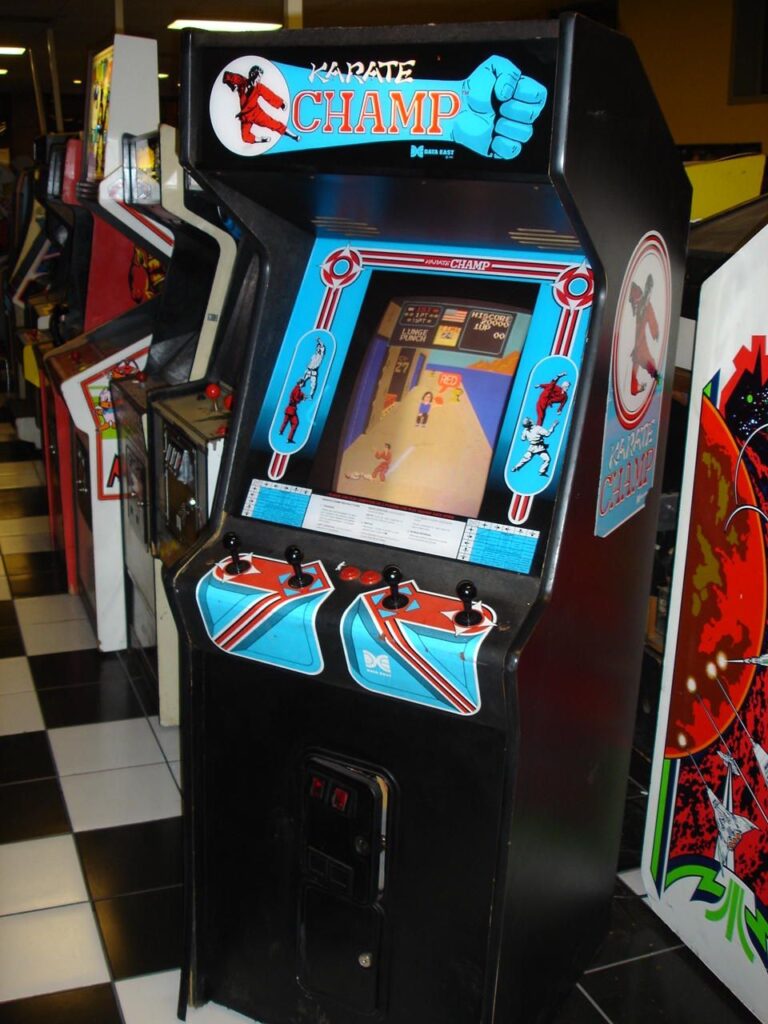
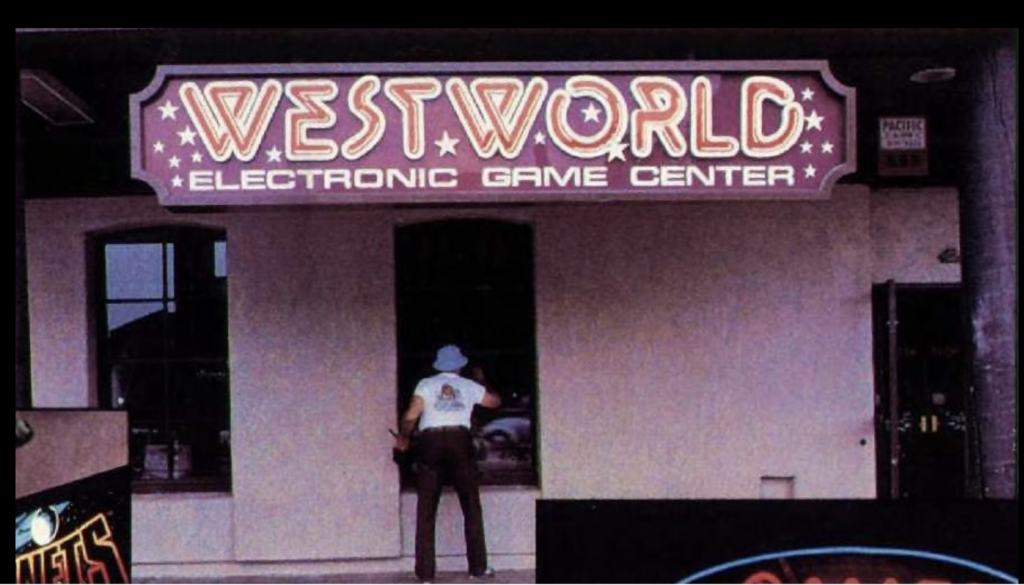
“Every Saturday, Mark and I would watch a movie at United Artists Cinemas Marina Del Rey then go to Westworld for pizza and a $10 roll of quarters to fight for 20 games. That is the real reason Karate Champ was put in the movie Bloodsport.”
(1985)
When Mark DiSalle later produced Bloodsport, the arcade competition that had become part of his real-life relationship with Rico was recreated on screen. Early in the movie, Frank Dux, played by Jean-Claude Van Damme, and Ray Jackson, played by Donald Gibb, meet over a Karate Champ machine before either man enters the Kumite.
The scene was not a random arcade-game placement.
It grew directly out of Mark and Rico’s real Karate Champ rivalry.
What had happened in the arcade became part of Bloodsport.
The Original Karate Champ
Released in the 1980s, Karate Champ helped establish the one-on-one martial-arts fighting game long before the genre became dominated by games such as Street Fighter and Mortal Kombat.
What made Karate Champ unique was its control system.
Instead of a joystick and attack buttons, each fighter was controlled with two four-way joysticks. Different combinations of the two sticks produced kicks, punches, blocks, jumps, defensive movements and other techniques.
That meant winning required more than rapidly pressing buttons.
Players had to learn timing. – Distance. – Movement.
And the combinations that made the fighter respond.
The Player Vs Player version turned the arcade cabinet into a direct martial-arts competition between two people standing shoulder-to-shoulder.
For Mark and Rico, it became exactly that.
A competition. – A rivalry. – And eventually, a small piece of movie history.
Karate Champ Meets Bloodsport
When Bloodsport reached audiences, millions of viewers saw Frank Dux and Ray Jackson meet through a Karate Champ machine before they faced the much more dangerous competition waiting for them inside the Kumite.
The arcade scene became one of the movie’s memorable early moments.
Two martial artists. – One machine. – A competition before the competition.
For most viewers, Karate Champ was simply a perfect arcade game for the scene.
Behind the movie, however, there was a personal reason it was there.
Mark DiSalle had already spent countless hours fighting those same battles against Enrico Rossi.
The real arcade rivalry became part of the fictional rivalry on screen.
40 Years Later — KUMITE CHAMP
Today that story comes full circle.
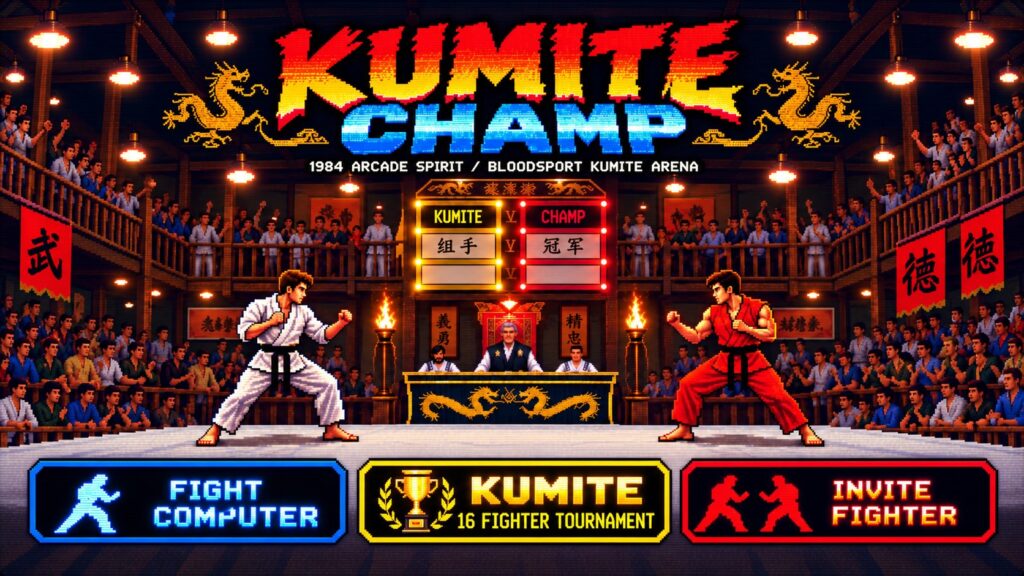
More than four decades after Enrico Rossi and Mark DiSalle were competing against each other at Karate Champ, that same head-to-head arcade experience has been brought into the Internet era.
Kumite Champ preserves the original Karate Champ: Player Vs Player fighting experience and its distinctive dual-joystick control system.
The original arcade game remains at the center of the experience.
The fighters. – The referee. – The scoring. – The movements. – The kicks. – The timing. – The classic Karate Champ gameplay.
But one major limitation of the original arcade cabinet has disappeared.
The two fighters no longer have to be standing beside each other.
One player can be in Los Angeles.
The other can be in Mexico City. – New York. – London. – Tokyo. – Or anywhere else in the world.
Each player controls his fighter from his own computer while Kumite Champ synchronizes the two players over the Internet, transforming the original local Player Vs Player arcade experience into online multiplayer competition.
You can also enter a 16 fighter Kumite Tournament.
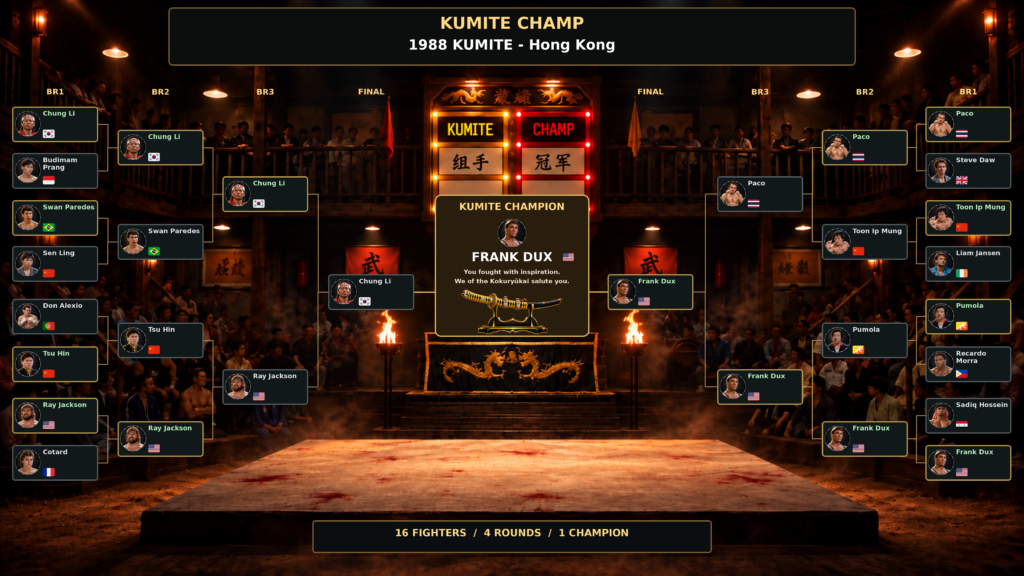
The arcade cabinet has become a global arena.
From the Arcade to the Internet
In the original Karate Champ, two players had to stand beside the same machine.
With Kumite Champ, those same two fighters can now compete from opposite sides of the world.
The concept remains simple:
Two human players.
Two fighters.
One match.
The technology behind it is completely different, but the competition remains true to the original game.
Kumite Champ adds the modern online layer around the classic arcade experience — allowing players to connect remotely, enter a match and fight each other using the game that helped define competitive martial-arts gaming.
The Circle Is Complete
1984
Karate Champ: Player Vs Player brings head-to-head martial-arts competition to the arcade.
1985
Mark DiSalle and Enrico “Rico” Rossi develop their own Karate Champ rivalry through repeated arcade battles.
1986
The Making of Bloodsport
Mark brings that real-life rivalry into the movie by using Karate Champ in the scene where Frank Dux meets Ray Jackson.
1988
Bloodsport reaches audiences around the world, and millions of viewers see Dux and Jackson battle each other at Karate Champ before entering the Kumite.
More than 40 years later
Enrico Rossi brings that same arcade competition online.
KUMITE CHAMP
The game that connected a real arcade rivalry to Bloodsport is fighting again.
16 Fighters.
One Kumite.
Anywhere in the World.